
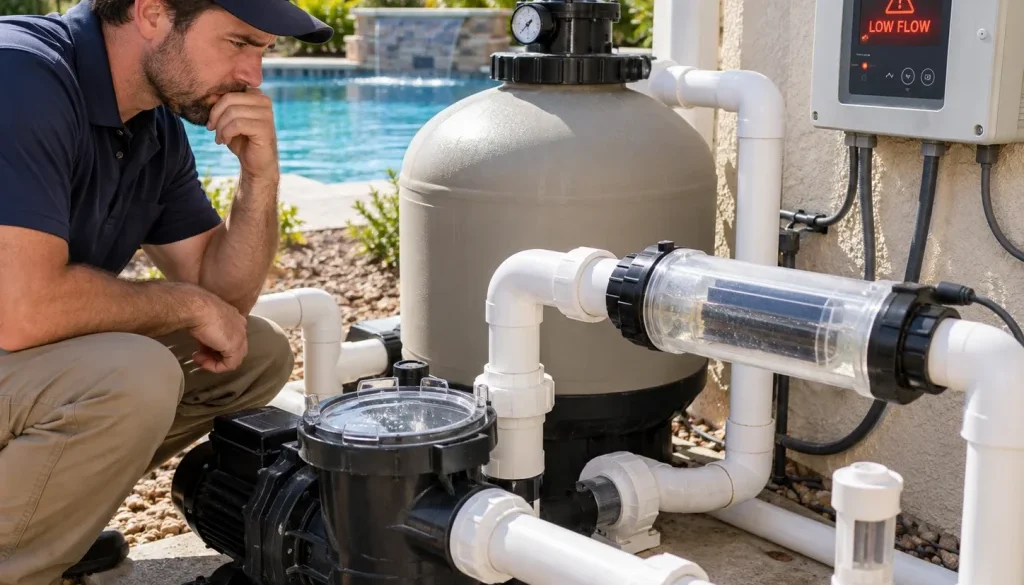
Poor Water Flow Can Prevent Your Salt Chlorinator From Working Properly
A salt chlorinator depends on steady water flow to produce and distribute chlorine throughout your pool. If circulation drops too low, the system may reduce chlorine output, trigger a flow warning, or stop generating chlorine altogether.
“Have you noticed your salt chlorinator showing a low-flow message even though the pool pump is running?“
The problem may come from a clogged filter, blocked skimmer basket, closed valve, dirty salt cell, low water level, or another circulation issue.
Understanding how water flow affects salt chlorinator performance can help you catch small problems before they lead to cloudy water, algae growth, or repeated sanitizer issues. This guide explains the common causes of poor flow, the warning signs to watch for, and what homeowners can do to keep the system working properly.
Key Takeaways
- Steady water flow supports chlorine production.
- Dirty filters can restrict chlorinator circulation.
- Low water levels may reduce flow.
- Pump problems can trigger flow warnings.
- Persistent flow issues need professional inspection.
Why Salt Chlorinators Depend on Steady Water Flow
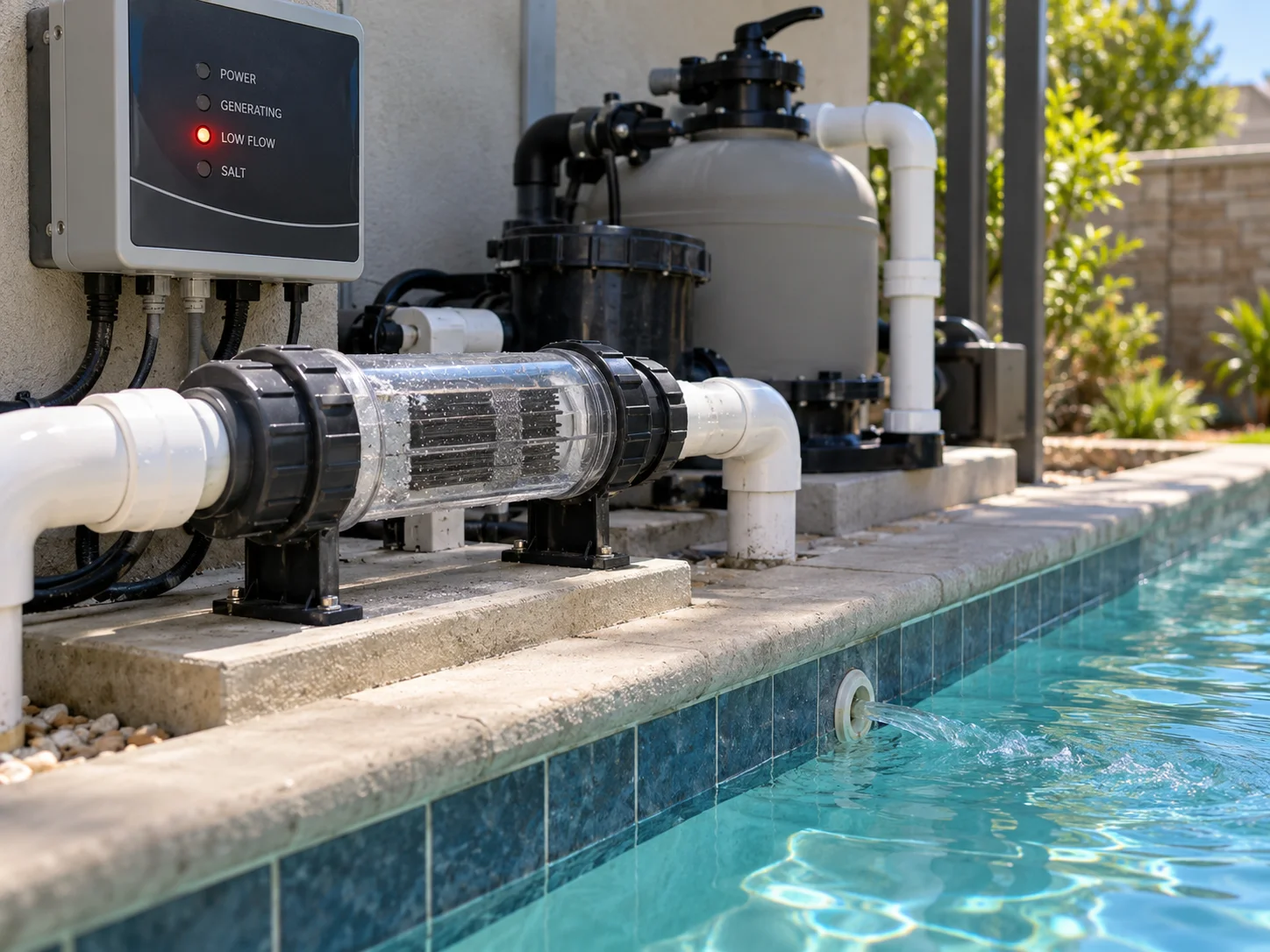
A salt chlorinator produces chlorine while pool water containing dissolved salt passes through its electrolytic cell. Inside the cell, electrical current converts chloride from the dissolved salt into chlorine, and the treated water then returns to the pool.
The chlorinator must detect sufficient water movement before chlorine generation can safely continue. Many systems include a flow sensor or flow switch that stops chlorine production when circulation falls below the equipment’s required level. Exact flow requirements vary by model, so homeowners should follow the specifications for their particular system.
Common Signs Your Chlorinator Is Not Getting Enough Flow
Poor circulation does not always begin with completely stagnant water. Your pump may still appear to be running while the chlorinator receives less flow than it needs.
Common warning signs include:
-
A low-flow or no-flow warning
-
Chlorine production suddenly stopping
-
Red or flashing flow indicator lights
-
Weak water movement from return jets
-
Pump pressure behaving differently than normal
-
Air appearing inside the pump basket
-
Chlorine levels gradually falling
-
Cloudy or dull-looking pool water
A flow warning should not automatically be treated as proof that the chlorinator itself has failed. The problem may originate elsewhere in the circulation system.
A Dirty Pool Filter Can Restrict Water Circulation
Your pool filter catches dirt, leaves, oils, and other particles as water passes through the system. As debris accumulates, resistance through the filter can increase and circulation can decline.
The proper response depends on the filter type. Cartridge filters may need cleaning, while sand and diatomaceous earth systems have their own maintenance procedures. Check the filter’s pressure against its normal clean operating pressure rather than relying on a single universal PSI number.
A noticeably restricted filter can reduce water reaching downstream equipment, including the salt cell.
Clogged Baskets Can Reduce Flow Through The System
Skimmer baskets and pump strainer baskets protect pool plumbing and equipment from larger debris. When they become packed with leaves, insects, pine needles, or other material, they can restrict the amount of water reaching the pump.
Homeowners should regularly check:
-
Skimmer baskets
-
Pump strainer baskets
-
Suction openings
-
Visible debris around drains
-
Pump lid condition
-
Water movement at return jets
A full basket may seem like a minor maintenance problem, but a heavily restricted suction path can substantially affect circulation.
Low Pool Water Levels Can Affect Chlorinator Performance
The pool’s water level also affects how efficiently the circulation system operates. If the water drops too low, a skimmer can begin drawing air along with water.
Air entering the suction side may cause the pump to lose prime or operate with unstable water flow. You may see bubbles under the pump lid, hear unusual sounds, or notice intermittent flow from the return jets.
Keeping the water near the normal operating level for the skimmer helps maintain consistent circulation through the filter and salt chlorinator.
Pump Problems May Reduce Flow To The Salt Cell
The pump is responsible for moving water through the entire circulation system. Problems with its speed, prime, or internal components can therefore affect chlorinator operation.
Several pump-related issues deserve attention.
Low Pump Speed
Variable-speed pumps allow homeowners to reduce motor speed during certain operating periods to save energy. However, a speed that works for basic circulation may not always meet the minimum flow requirement of a particular chlorinator.
For example, some current salt chlorine generators specify a minimum flow rate before their internal flow switch activates. That requirement is model-specific rather than universal.
If a flow warning appears only at lower programmed pump speeds, the pump schedule and chlorinator specifications should be compared.
Pump Losing Prime
A pump that repeatedly fills with air may not be able to maintain steady water movement.
Possible causes include low pool water, a loose pump lid, damaged lid O-rings, suction-side leaks, or blocked plumbing. Repeated loss of prime should be investigated rather than treated only by restarting the pump.
Worn Pump Components
A worn or damaged impeller can also reduce circulation. Debris can sometimes clog the impeller and limit how much water the pump can move.
Internal pump problems generally require more careful inspection because opening or servicing pool equipment incorrectly can cause additional damage.
Closed Valves Can Restrict Water Flow
Pool valves control where water enters and leaves the circulation system. Valve positions may be changed during maintenance, vacuuming, winterization, equipment repairs, or operation of water features.
A valve accidentally left partly closed can restrict suction or return-side flow. Incorrect bypass valve positions can also affect how much water passes through certain equipment.
Before adjusting unfamiliar valves, note their current positions. Incorrect valve changes can interfere with other pool systems.
A Dirty Salt Cell Can Create Additional Problems
Mineral scale can accumulate on a salt cell, particularly when water chemistry encourages calcium deposits. Heavy buildup can interfere with cell performance and restrict water passages in some cell designs.
Cell inspection should follow the manufacturer’s instructions. Some chlorinators include indicators that tell homeowners when cell inspection is needed.
Cleaning should also be performed only when necessary and according to the manufacturer’s procedure. Repeated aggressive acid cleaning can damage cell coatings and unnecessarily shorten service life.
Pro Tip: If your chlorinator shows a flow warning, check the simple circulation points before assuming the salt cell needs replacement. Look at water level, baskets, filter condition, pump operation, valve positions, and return flow first.
Flow Sensors Can Trigger Warnings Despite Normal Circulation
Sometimes water appears to be circulating normally, yet the chlorinator continues reporting a flow problem. In that situation, the flow sensor or switch itself may need inspection.
Flow-detection components tell the chlorinator whether enough water is moving through the cell. Some systems automatically stop electrolysis when insufficient flow is detected and resume operation once proper circulation returns.
Scale or debris can also interfere with certain flow, temperature, and salinity sensors. Manufacturer guidance for some systems specifically calls for sensor cleaning when deposits affect readings.
A persistent warning should therefore be diagnosed systematically rather than solved by immediately replacing the entire chlorinator.
Common Flow Problems And Their Symptoms
Several circulation problems can create similar chlorinator warnings. Comparing the symptoms can help narrow down where to begin checking.
| What You Notice | Possible Cause | Other Clues | First Check |
|---|---|---|---|
| Low-flow warning | Restricted circulation | Weak return jets | Check baskets and filter |
| Warning at low pump speed | Pump speed below required flow | Warning disappears at higher speed | Review pump programming |
| Air inside pump basket | Suction-side air entering system | Pump may lose prime | Check water level and pump lid |
| Strong return flow but warning remains | Flow sensor problem | Chlorinator remains offline | Inspect sensor or switch |
| Flow gradually becomes weaker | Dirty filter or blockage | Filter pressure may change | Service filter and inspect baskets |
| Repeated cell warning | Scale or cell contamination | Visible deposits may appear | Inspect cell per manufacturer instructions |
The same symptom can have more than one cause, so troubleshooting should consider the entire circulation path.
What Happens If Poor Water Flow Continues
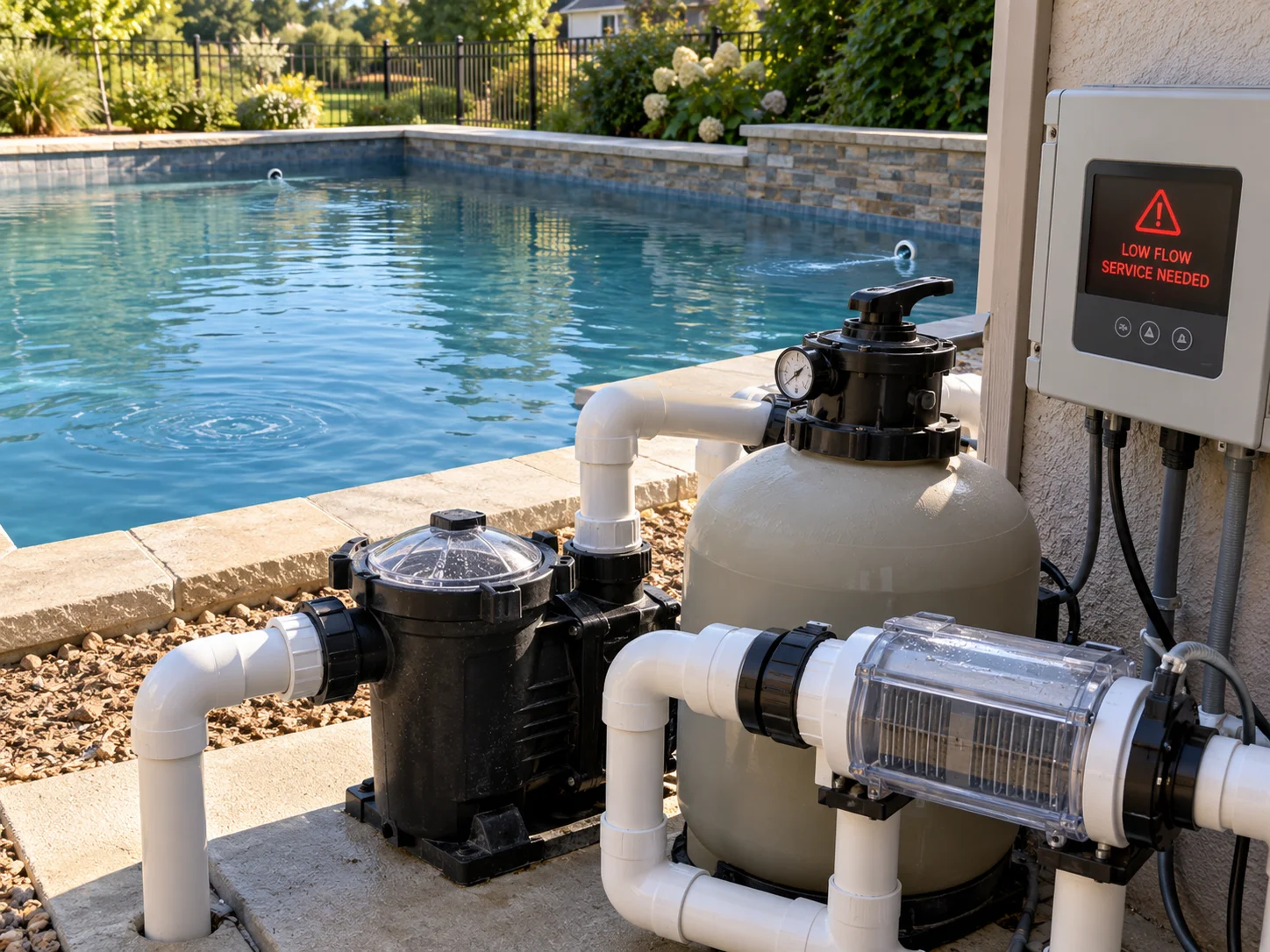
A salt chlorinator that stops generating chlorine cannot maintain sanitizer levels by itself. If the condition continues, free chlorine may decline as chlorine is consumed by sunlight, swimmers, organic contamination, and normal pool demand.
Low sanitizer can eventually contribute to cloudy water and algae growth if the problem is not corrected.
Poor circulation can also reduce filtration effectiveness. Water needs to move through the filter so suspended particles can be removed, making proper circulation important for more than chlorinator operation alone.
Simple Checks Homeowners Can Make First
Several basic observations can help determine whether the problem comes from general circulation or the chlorinator itself.
Start by checking:
-
Pool water level
-
Skimmer basket condition
-
Pump basket condition
-
Strength of return-jet flow
-
Filter pressure compared with normal
-
Pump speed or schedule
-
Visible air inside the pump
-
Valve positions
-
Chlorinator display messages
-
Visible salt-cell scaling
Avoid adding salt solely because chlorine production is low. Poor chlorine production can have several causes, including inadequate runtime, dirty cell blades, water chemistry, environmental demand, and salt concentration.
Testing the water before making chemical adjustments can prevent unnecessary corrections.
When Poor Flow Needs Professional Diagnosis
Basic maintenance may solve a clogged basket or dirty filter, but repeated flow problems can point to equipment or plumbing issues that need closer inspection.
Professional diagnosis may be appropriate when:
-
Flow warnings return repeatedly
-
The pump regularly loses prime
-
Strong circulation exists but the warning remains
-
The pump cannot maintain expected flow
-
Cell buildup returns quickly
-
The chlorinator does not restart after normal flow returns
-
A plumbing obstruction is suspected
-
A flow switch or sensor may be malfunctioning
Testing each part of the circulation system can help prevent unnecessary salt cell or chlorinator replacement.
Keep Your Salt Chlorinator Working With Proper Pool Circulation
A salt chlorinator cannot perform properly without dependable water movement through the cell. Low water, clogged baskets, dirty filters, incorrect pump speeds, valve restrictions, scale, and sensor problems can all interfere with normal operation.
Paying attention to changes in return flow, pump behavior, and chlorinator warnings can help you address circulation problems before pool water quality begins to suffer.
If your salt chlorinator keeps displaying flow warnings or has stopped producing chlorine, Contact Us at Residential Pool Service LLC for professional inspection and salt water chlorinator service.



