
How to Tell if Your Pool Heater Is Too Small for Your Pool
A pool heater that is too small can struggle to raise the water temperature efficiently, especially during cooler weather or when heating a large pool. Instead of reaching the desired temperature quickly, the system may run for long periods and still leave the water feeling colder than expected.
“How can you tell if your pool heater is simply working hard or actually undersized for your pool?”
Warning signs often include slow heating, difficulty maintaining temperature, frequent operation, and higher energy use. Understanding these signs can help you decide whether your current heater is properly matched to your pool’s size and heating needs.
Key Takeaways
- Proper heater sizing improves pool comfort.
- Slow heating may indicate undersized equipment.
- Poor circulation can mimic sizing problems.
- Pool covers help reduce heat loss.
- Climate affects overall heater performance significantly.
What Pool Heater Size Actually Means
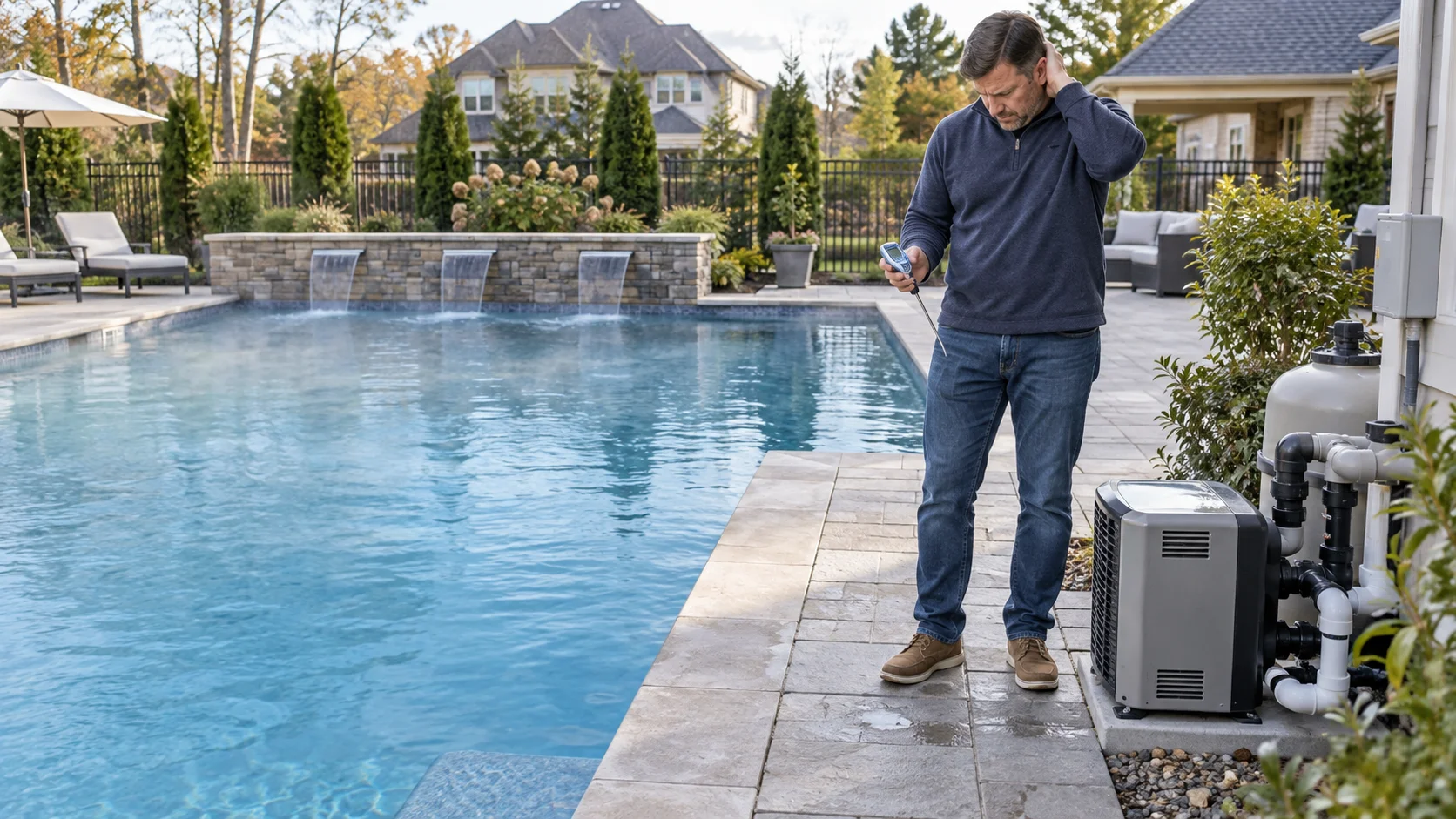
Pool heater size refers primarily to heating output rather than the physical dimensions of the equipment. Gas pool heaters are commonly rated by British thermal units, or BTUs, while heat pump pool heaters also have an output capacity that determines how much heat they can transfer to the water.
A higher heating capacity can generally raise pool temperature faster, but selecting a heater involves more than simply choosing the largest model available. Pool size, desired water temperature, climate, exposure, and expected heating time all affect the amount of heating capacity you need.
Signs Your Pool Heater May Be Too Small
An undersized heater may still produce warm water, making the problem less obvious than a complete equipment failure. The difference usually becomes noticeable in how long the heater operates and how well it handles demanding conditions.
Common warning signs include:
- Your pool takes much longer than expected to warm.
- The heater runs for extended periods without reaching the thermostat setting.
- Water temperature drops faster than the heater can recover.
- Heating performance becomes noticeably worse on cooler days or nights.
- The heater rarely shuts off while you are trying to maintain warm water.
- Your heating costs seem high compared with the comfort you receive.
These symptoms do not automatically prove that the heater is undersized. Restricted water flow, dirty filters, equipment problems, and excessive heat loss can produce similar symptoms.
How Pool Size Affects Heater Performance
The amount of water being heated has a major influence on heater requirements. A large pool contains more water that must absorb heat before the overall temperature increases.
Pool Volume Matters
Water requires a predictable amount of heat to change temperature. One BTU is approximately the amount of energy needed to raise one pound of water by one degree Fahrenheit.
Because a gallon of water weighs about 8.34 pounds, larger pools require considerably more energy to produce the same temperature increase. A heater that performs well on a small residential pool may provide frustratingly slow results on a much larger one.
Temperature Rise Matters
The difference between the current water temperature and your target temperature is equally important. Raising water from 78°F to 82°F requires much less energy than raising it from 65°F to 82°F.
Homeowners who regularly want large temperature increases may therefore need more heating capacity than someone who simply maintains a relatively stable water temperature.
Heating Time Matters
Two homeowners with similarly sized pools can have different heater needs because they use their pools differently. Someone who wants to heat the pool quickly before occasional weekend swimming may prioritize faster heating.
Someone who maintains a consistent temperature for long periods may use a different heating strategy. ENERGY STAR notes that gas-fired pool heaters are particularly suited to occasional rapid heating, while heat pumps can be useful for keeping water within a set temperature range over longer periods.
Problems That Can Mimic an Undersized Heater
Slow heating does not always mean you need a larger heater. Problems elsewhere in the circulation or heating system can prevent even a correctly sized unit from operating as intended.
The following conditions are worth checking before deciding that heater capacity is the problem.
| Possible Problem | Effect On Heating | What You May Notice |
|---|---|---|
| Restricted water flow | Reduces proper circulation through heater | Slow heating or heater shutdowns |
| Dirty pool filter | Restricts circulation | Poor performance and reduced flow |
| Heat exchanger scaling | Interferes with heat transfer | Longer heating cycles |
| Cold outdoor temperatures | Increases heat loss | Difficulty maintaining temperature |
| Strong wind | Increases evaporation and heat loss | Water cools more quickly |
| Uncovered pool | Allows substantial heat loss | Longer heater operation |
A professional inspection can help separate a capacity problem from a maintenance or equipment issue. Replacing a heater without identifying the actual cause could leave the original heating problem unresolved.
Pro Tip: Track the pool temperature before starting your heater and again several hours later under similar weather conditions. Consistently poor temperature gains can provide useful information when evaluating heater performance, but circulation, weather, and heat loss should also be considered.
How Weather And Climate Affect Heater Sizing
Outdoor conditions can dramatically change how hard a pool heater has to work. The colder the surrounding air becomes, the faster heated pool water can lose energy to the environment.
Wind can make the situation worse by increasing evaporation. This means a heater that performs adequately during mild afternoons could struggle to maintain the same water temperature during cool, windy evenings.
Heat pump pool heaters are particularly influenced by ambient conditions because they extract heat from surrounding air. Department of Energy information shows that heat pump capacity and efficiency depend partly on outdoor air temperature, humidity, and pool water temperature.
Why Pool Covers Affect Heating Performance
A pool cover can significantly change the amount of energy required to maintain comfortable water temperatures. Evaporation is one of the biggest sources of heat loss from swimming pools.
The U.S. Department of Energy reports that covering a pool can substantially reduce evaporation and may reduce pool heating costs by 50% to 70%, depending on conditions and usage.
Using a cover whenever the pool is not in use can therefore reduce the workload on your heater. An apparently undersized heater may perform much better when unnecessary overnight heat loss is controlled.
How To Estimate The Right Pool Heater Size
Choosing heating capacity requires looking at the entire swimming environment rather than relying on pool gallons alone. Accurate sizing helps balance heating speed, equipment requirements, and operating costs.
Important factors include:
- Pool surface area
- Total water volume
- Current water temperature
- Desired swimming temperature
- Typical outdoor temperatures
- Wind exposure around the pool
- Desired heating speed
- Frequency of pool use
- Use of a pool cover
- Heater type and efficiency
- Available gas or electrical capacity
Manufacturer sizing information is useful, but actual site conditions can influence the final selection. A professional can evaluate these factors together instead of basing the decision on a single measurement.
Gas Heater Vs Heat Pump Sizing
Gas pool heaters and heat pumps produce heat differently, so homeowners should not evaluate them using exactly the same expectations. The best choice depends partly on how and when you heat the pool.
Gas Pool Heaters
Gas heaters burn fuel and transfer the generated heat to circulating pool water. Their relatively high heating output makes them useful when faster temperature increases are important.
They can be especially practical for pools that are heated occasionally instead of being held at one temperature continuously.
Pool Heat Pumps
Heat pumps transfer available heat from outdoor air into the pool rather than creating most of their heat directly through fuel combustion. They generally warm pools more gradually.
Their performance also changes as weather conditions change. Cooler outdoor temperatures can reduce available heating capacity, so climate should be considered carefully when choosing and sizing a heat pump.
Problems Caused By An Undersized Pool Heater
A heater that cannot keep pace with your pool’s heating demand may spend much of its operating time trying to catch up. The result can be disappointing even when the equipment itself has no mechanical defect.
Homeowners may experience:
- Extremely long heating cycles
- Difficulty reaching the desired temperature
- Poor temperature recovery after cold nights
- Constant heater operation
- Increased energy consumption
- Reduced swimming comfort
- Limited usefulness during cooler months
An undersized system can be especially frustrating when homeowners expect rapid heating. It may technically produce heat while still failing to deliver the heating performance needed for the way the pool is used.
Can A Pool Heater Be Too Large?
Choosing the largest possible heater is not automatically the best solution. Installation requirements, equipment compatibility, available utilities, upfront cost, and manufacturer specifications still matter.
For gas heaters, the home’s gas supply and venting requirements must support the equipment. Electrical demand, plumbing configuration, flow requirements, clearances, and local installation requirements can also affect which heater can safely be installed.
Correct sizing means finding enough capacity for the pool and the homeowner’s heating expectations without ignoring the rest of the pool system.
When Pool Heater Replacement Makes More Sense
Repair is often worthwhile when the heater is appropriately sized and the problem involves a serviceable component. Replacement becomes more reasonable when the equipment cannot meet the pool’s needs even after maintenance and repairs are addressed.
Replacement may deserve consideration when:
- The existing heater is significantly undersized.
- Heating performance has never met expectations.
- Major repairs are becoming frequent.
- Important components show extensive corrosion or deterioration.
- The pool has been enlarged or remodeled.
- Swimming habits have changed.
- You want faster heating or a longer swimming season.
- An older heater no longer provides acceptable efficiency or reliability.
A technician should evaluate the current heater before recommending replacement. Problems such as inadequate circulation or improper controls can sometimes be corrected without installing a new unit.
Choosing The Right Heater For Reliable Pool Comfort
A pool heater that seems too small may genuinely lack enough heating capacity, but poor circulation, excessive heat loss, weather conditions, and equipment problems can create many of the same symptoms. Looking at the entire system is the best way to identify what is limiting performance.
Proper heater sizing should account for pool volume, desired temperature rise, climate, heating speed, and how frequently the pool is used. Matching those factors can give homeowners more predictable heating without making the heater work harder than necessary.



